Showing posts with label lifestyle. Show all posts

Thursday, January 3, 2013

an artsy GREAT LAKES surf vid, then some important biz

Here's an artsy cool little video made by some fellow Great Lakes surfers who hit Sleeping Bear dunes over New Years.  After the film, please read and learn about the Great Lakes Surf Rescue Project... they are doing some amazing work that we desperately need!


GREAT LAKES CAN MEAN GREAT PERIL
Drowning Epidemic
Public education in concert with safety measures a must

Since 2010 more than 262 people have drowned in the Great Lakes.  Eight of these fatal drownings recently occurred over this year’s Labor Day weekend

Karl W. Schmidt, 60, a grandfather, was one of those drownings.  He was enjoying Lake Michigan with his family over the holiday weekend when tragedy struck his 9-year-old grandson who was pulled from shore.  Schmidt was able to pass the boy to nearby surfers who took him to shore.  Sadly in the confusion Schmidt had used his last ounce of energy to save the boy and went under.

Bystanders began a frantic search and found his body 200 yards from shore where surfer, Burton Hathaway, paddled him in.  Schmidt’s children, grandchildren, and hundreds of holiday beach goers watched in desperation as bystanders performed CPR until officers and first responders arrived.  

(Rescue workers perform lifesaving efforts to Karl Schmidt)

Family and beach goers continued to watch Schmidt, unresponsive to the chest compressions, as he was carried from the water’s edge to a waiting ambulance.

The same day, Tyler Buczek, 15, an 8th grade valedictorian and incoming freshman quarterbackdisappeared in the waves at a Port Washington, WI beach as his closest friends watched.  

One of his friends was quoted as saying, “We're all freshmen.  It’s supposed to be we're all happy, we're in high school.  But I don't think that's going to be how it is this year.”   

Those who know Tyler recalled a boy with a big future.  He was supposed to start his first day of high school, but instead songs, prayers and tears flowed as nearly 1,000 people gathered for his beachside vigil to support the teenager's family.

Now multiply these tragic stories by 262 and counting and know that these drowning numbers will continue to rise unless a uniform water safety education program is in place.  

Two men and a mission
Bob Pratt and Dave Benjamin have worked fulltime for more than two years without pay in an effort to save lives through their nonprofit organization, the Great Lakes Surf Rescue Project(GLSRP). 

Since 2010 they have been tracking drowning statistics and, in the summer of 2011 and 2012, they performed 17 “Water Safety Surf Rescue” classes on the beaches and in the waters of Lake Michigan and Lake Superior.  People who attended the classes consisted of the general public, surfers, lifeguards, Department of Natural Resource (DNR) officers, police officers, fire fighters, paramedics, water rescue team members, dive team members, and the U.S. Coast Guard. 

The GLSRP intends to expand its classes to all five Great Lakes, create a Water Safety Rip Current Survival national curriculum, in order to reduce these drownings.

Pratt recently retired after 25 years of service as paramedic, fire fighter, and fire marshal for the city of East Lansing, MI to take the helm of the GLSRP full-time.  He is also a certified lifeguard, CPR, and first aid instructor and has served as the lead trainer for the fire department’s water and ice rescue training as well as several police and fire agencies in Michigan including Lansing Community College’s Police Academy.  

Pratt became an advocate for Great Lakes water safety when he was going to teach his son to surf September 3, 2003.  On that day at the beach, U.S. Coast Guard helicopters and boats were in the water searching for Andy Fox, who got caught in a rip current at Grand Haven State Park. 

“We spent some time on the beach just reflecting and were deeply affected by the sight,” said Pratt.  “I was appalled to learn how common drownings were on the Great Lakes. Very few beaches have lifeguards, and bystanders are often the only hope a drowning victim has.”

Fox's death sparked Pratt’s interest in rip currents and he later worked with Fox's mom on several projects including the “Great Lakes Beach and Pier Safety Task Force” and the “Beach Safety Challenge”.

Benjamin has swum in Lake Michigan for 42 years and started surfing the Lake in 2009.  While surfing in 2010 he survived a nonfatal drowning accident which prompted his dedication to this cause.

“After swimming in the lake my whole life, I was pretty comfortable in the water,” said Benjamin, executive director of the GLSRP.  “But all it took was one moment of panic for all experience and rational thought to go out the window.”

According to Benjamin when he was drowning, he remembered an article titled, “Drowning doesn’t look like drowning” by Mario Vittone and it saved his life. 

“I was doing all the signs [of drowning] and when I stopped doing the signs I was able to eventually float to safety.”

This summer Benjamin participated in an unsuccessful water rescue and witnessed several bodies pulled from the water. 

“Going to the beach is supposed to be about family fun, recreation, love and happiness.  Not about tragedy, despair, and hopelessness,” Benjamin concluded.


THE SOLUTION
The GLSRP is working with the Michigan Sea Grant’s “Flip, Float, and Follow” rip current survival strategy, to develop a national curriculum similar to the Fire Prevention Services’ “Stop, Drop and Roll” program.

“Ask anyone anywhere in the United States and they probably know ‘Stop, Drop and Roll,’” Benjamin aptly noted, hoping “Flip, Float, Follow” can catch on as well.”


The GLSRP has been promoting the Michigan Sea Grant’s “Flip, Float, and Follow” rip current survival strategy through its “Water Safety Surf Rescue” classes this summer and it has receivedover 30 media mentions.

With some funding, the GLSRP is ready to launch a regional and then national water safety curriculum to teach the public how to:
·         Recognize the dangers and hazards of the Great Lakes surf environment keeping personal safety as THE primary responsibility
·         Implement Hands-on Adult Supervision –
·         Designate Water Watchers (The Water Watcher Card)
·         Recognize the “Signs of Drowning” – How to identify a person in trouble from within a crowd (The Hollywood version of drowning vs. the actual version of drowning)
·         Understand rip currents; i.e. how, where, and why rip currents occur;
·         Know the Dangerous Currents
·         Know the dangers of Offshore Winds
·         Use a flotation device or surfboard to rescue a person in distress or in a rip current
·         React when encountering swimmers who have suffered an injury or unconscious
·         Enroll in lifesaving, first aid and CPR training from accredited agencies.
·         Use the Michigan Sea Grants “Flip, Float, and Follow” rip current survival strategy

The Price of Apathy
If no uniform public water safety curriculum is funded, the Great Lakes drowning epidemic will definitely continue to rise, especially as the beaches receive national recognition and multimillion dollar restoration projects are under way.  More attractive beaches result in more bathers and, without effective intervention, more drownings.

Although the GLSRP is a young organization, it has made some huge accomplishments in less than two years and is ready to handle the challenge of delivering this national water safety curriculum.

PROPOSED INDIANA RIP CURRENT SWIM BAN
Indiana State Senator Jim Arnold is drafting legislation that, if passed, will make it illegal to swim in Lake Michigan when rip current warnings are issued.

Arnold was quotes as saying, “The whole purpose of this is to save lives and protect people who have shortcomings (with understanding how dangerous these conditions are).  This law provides a way to enforce this. This is a public safety issue.”

The bill would exempt those who want to surf Lake Michigan provided they wore the proper safety gear.

According to the Great Lakes Surf Rescue Project, on average, fifty percent of all Great Lakes drownings occur in Lake Michigan and fifty percent of Lake Michigan drownings occur on the south end of the Lake from Chicagoland to the Indiana/Michigan border.  Approximately one-third of all Great Lakes drownings are rip current related.

“We are thankful that there is interest in water safety, but drowning is a complex problem and we need to make sure the lawmakers realize that this will not keep every swimmer out of the water nor prevent all drownings,” said Bob Pratt executive director of education of the Great Lakes Surf Rescue Project. 

“Rip currents are only a piece of the drowning puzzle on the Lake.  Without addressing all of the factors that lead to drowning, we are not addressing the problem; factors such as the lack of lifeguards at most beaches, the lack of adult supervision, other dangerous currents, offshore winds, Seiches, or localized winds that arise before the National Weather Service can issue a warning.”

“This law may reduce a few drownings but we really need a comprehensive plan to address all the factors and not leave enforcement and interpretation to local jurisdictions.”

Pratt recently returned from the International Rip Current Symposium in Sydney, Australia where he presented the work of the Great Lakes Surf Rescue Project and the Great Lakes drowning epidemic.  In March Pratt will be presenting a Stand-Up Paddleboard curriculum at the National Drowning Prevention Alliance’s 12th Annual Symposium in Fort Lauderdale, Florida.

MAJOR BEACH RESTORATION PROJECTS
Amidst the drowning fatalities and possible swim ban, in Northwest Indiana there are two beach restoration projects totaling $70 million, which will bring even more people to the lakefront.

In Gary the Northwest Indiana Regional Development Authority (RDA) provided a $28 milliongrant for the Marquette Park Lakefront East Project.  “It will create an economic boom nearby and bring people to this important piece of shoreline,” said RDA Executive Director Bill Hanna.  In Whiting the focus of the $42 million redevelopment project is to transform the Whiting Lakefront Park into a destination point for all to enjoy.

“With all of this money for restoration projects designed to bring more people to the beaches, you have to ask the question, ‘How much money or funding is allocated for water safety drowning prevention programs,’” Benjamin said.

“These drowning numbers do not happen on the east coast and west coast combined, so what are they doing on the coasts that are not being done on the Great Lakes?”


###

Become a member of the Great Lakes Surf Rescue Project.  The Great Lakes Surf Rescue Project, Inc. (GLSRPis about saving lives.  It is a nonprofit corporation that is a Chapter of the National Drowning Prevention Alliance (NDPAthat tracks drowning statistics, teaches “Water Safety Surf Rescue” classes, and leads the “Third Coast Ocean Force” rip current awareness campaign on the Great Lakes.

It presented at the 2nd International Rip Current Symposium Nov. 1st, 2012 in Sydney, Australia; the 2012 winner of the “Outstanding Service to the Great Lakes Community” award presented by the Dairyland Surf Classic; the 2011 “Lifesaver of the Year” award winner; and a presenter at the NDPA’s 11th Annual Symposium in San Diego, March 9, 2012.

Saturday, December 29, 2012

a little school and a board review... then some fun in the sun


As I mentioned in my last post, I'm in the process of testing a fleet of 6 SUP surfboards of different sizes and shapes to shed some light on what makes a great Great Lakes surf SUP.  In order to understand what makes these boards different, let's go over some basic board design elements that we'll also use as test criteria.  Here are the basic design characteristics we'll be looking at:

1. Size - By size we mean the board's dimensions (that's length, width, thickness and volume).  As a rule, bigger people and less experienced surfers should be on bigger boards.

2. Outline - This is the board's basic shape when you look at it deck side up, straight on.  Notice how the rails curve, where the widest area of the board is and how narrow it gets (or doesn't get) toward the tail.

3. Rocker - Rocker is the curve the board has when you look at it from the side.  More rocker makes a board look something like a banana, and less rocker makes it look flat.    

4. Bottom Shape - Many people don't even look at bottom shape when choosing a board, which is a big mistake.  A lot of a board's performance comes from subtle, precise shaping that the board's designer carves into the blank.  Bottom shapes can be simple or complex, but the theme here is flow.  Bottom shape is all about how the water flows under the board.  

5. Fin Setup - Boards come with different fin setups - single-fins, thrusters (three fins) and quads (four fins) are the most common.  


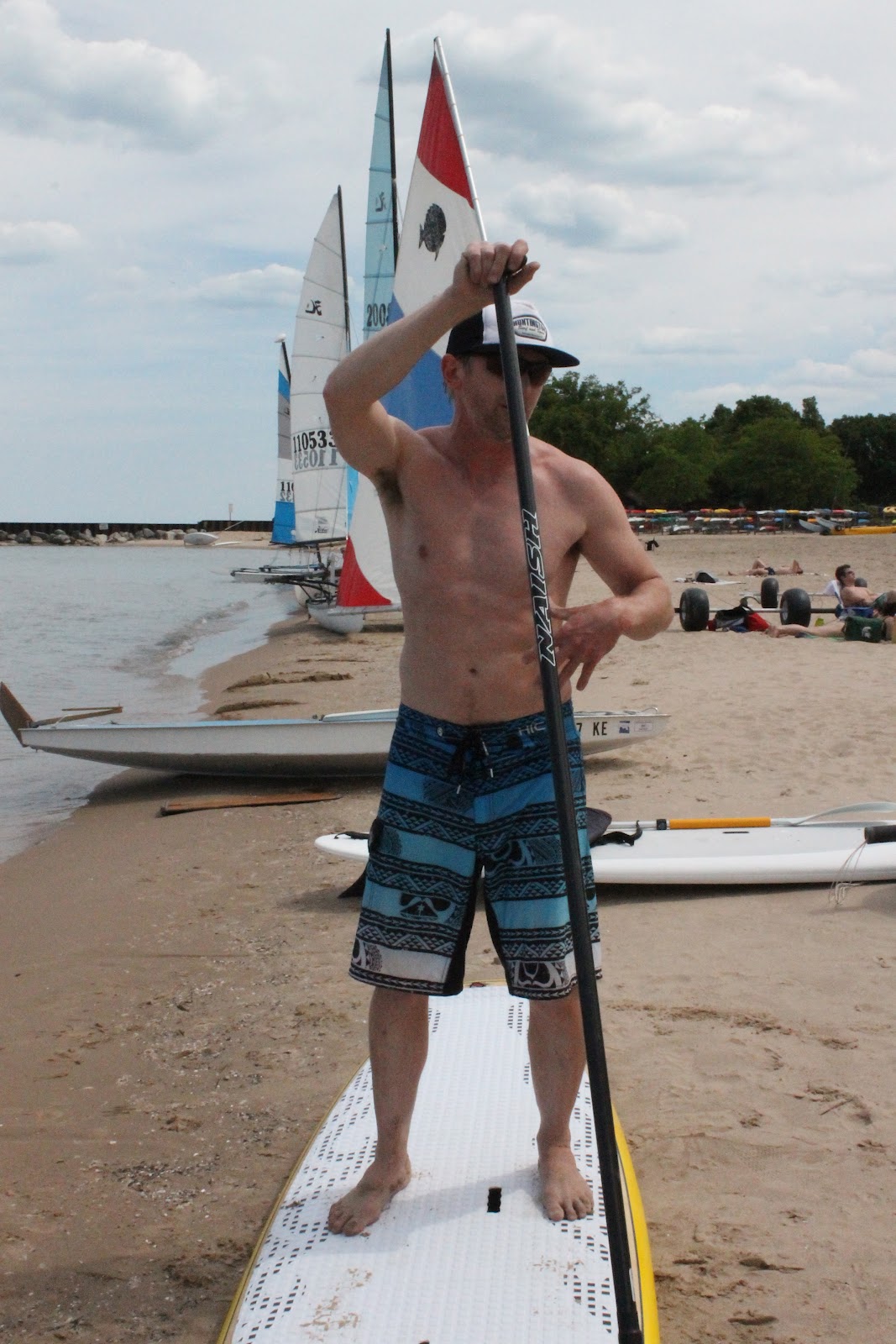
As I test these boards I'll go over the design characteristics and talk about how they affect the ride.  I'll also offer recommendations on what type of surfer and conditions the board would work well for.  The first board I'll be reviewing is the Starboard Wide Point 9'5", which I'm riding in the photo above.  I've had this board since last August and I've surfed it a lot, both on the Great Lakes and in ocean waves in New York and New Jersey.  So here you go:

Board Review - Starboard Wide Point 9'5"

1. Size - The Wide Point line from Starboard comes in five lengths from 10'5" down to an astoundingly short 7'8".  Every board in the line is 32" wide at its wide point, thus the name.  Here's a breakdown on the dimensions of the 9'5" WP:
  • Length - At 9'5" long, this board leans more toward surf than flat water.  If you want to do anything other than the most casual flat water paddling, this board is really too short.  That said, I've enjoyed taking the 9'5" WP out on flat days to practice agility, explore or put my daughter on the front and just goof around.  It's still fun, but without the glide of a longer waterline.  The board was really designed to surf, and it does this really well.  If you're used to surfing a bigger all around SUP board, the shorter length is AMAZING!  The reduced swing weight makes the board way easier to turn and maneuver.  My surfing has improved 10-fold since I got on this board... so much so that now I'm looking to drop down to an even shorter board.  
  • Width - 32" wide is a real sweet spot for SUP boards, and the designers at Starboard have obviously keyed in on this fact.  This board is incredibly stable, as are it's shorter cousins in the Wide Point line.
  • The 9'5" is 4.3" thick and comes in at 155 liters of volume, enough to comfortably float a person up to 200 pounds (or a bit more if they're a fairly experienced paddler).    
2. Outline - The WP boards all have a consistent contour that is pleasing to the eye.  The widest part of the board is under and in front of the standing area.  This gives the rider great stability when paddling and also helps the board get on a plane early when you drop into a wave.  The rails are nicely drawn in toward the tail for fantastic turning ability.

3. Rocker - The 9'5" WP has a relatively flat rocker in the middle with a generous nose rocker and a moderate tail rocker.  The nose rocker keeps the board from pearling, or nose-diving into the water during take off.  The tail rocker makes the board lively in the turns.  

4. Bottom Shape - All the boards in the WP line feature a mono concave bottom.  This has been my first experience with the mono concave and at first I wasn't sure what to think about it.  As time went on and I was able to ride the WP next to many other boards, I started to understand (everywhere I go people want to try my WP, so I swap boards a lot).  The mono concave bottom helps keep the board stable and greatly increases control on the wave.  Compared to other boards I've been on with a more traditional V shape, the WP feels like it's on rails.  

5. Fin Setup - the WP comes with a thruster fin set - that's three fins, a larger center fin the back and two smaller fins on either side and in front of the center fin.  It can also be set up as a quad with four smaller fins.  I've surfed it both ways and they both work well.  The thruster set allows you to do a nice drawn out, classic bottom turn.  The quad makes the board turn quicker and slash-ier.  


Here's an outline shot of the 9'5" WP along with specs from the Starboard website

Overall, I've found this board surfs well in everything from mushy Great Lakes ankle slappers to head-high point break in Montauk, NY.  I don't think they're overselling it on the Starboard website when they call the 9'5" WP "The right choice for most people getting into wave riding."  For it's versatility, I would recommend this board for anyone who wants a one-board Great Lakes surf quiver.  For it's stability, I would recommend it for novice surfers under 180 pounds or intermediate to advanced surfers of any size.  For it's fun factor, I'd recommend that any paddler who's out there surfing a big all around shape try the 9'5" Wide Point and see what you're missing.  

OK... school's out for the day.  That was fun to write and I hope you learned a little something about board design.  Now here comes your treat... a three-part video series shot by Oxbow in French Polynesia featuring a band of intrepid watermen and women exploring the atolls on a 50-foot sailboat.  I ran into this the other day and it made me feel all nostalgic for my own past adventures living on sailboats and exploring unknown waters.  If only we'd had SUP's back then...   These videos are each about 10 minutes long, so grab a refreshing beverage, put your feet up, and enjoy a little fun in the sun.  See you on the water!


Wednesday, September 19, 2012

long island

Windy City Waterman is on the road.  Last week we pointed the Element toward the rising sun then put the pedal to the floor and kept it there until our toes were in the ocean.  Here are some pics from the first stage of our epic trip...


Once we landed on Long Island, I rang up Hampton Watersports to inquire as to where we might do a bit of windsurfing.  "Mattituck Yacht Club" was the answer and the right one at that.  It was blowing 25 knots when we arrived and over 40 by the end of the session.


Unfortunately I had only brought sails down to 5.5, but on the beach I met Jimi, who was missing a few vital rig components.  Between the two of us we pulled together a 4.2/75 ltr kit and hit the water, taking turns enjoying the epic conditions.  I mounted the GoPro to the boom, so look forward to a nice video in the near future.


I was watching this lanky fellow throw forward loops on the water and when he came in he just seemed familiar... turned out to be Jace Panebianco, former PWA pro turned film maker (and not just late night skin-emax films either... Sorry Jace but some things can never be forgotten).  Jace is the man behind The Windsurfing Movie and The Windsurfing Movie II.  If you haven't seen them, stop reading this and go find a copy.  They are must have's for any windsurfer.


Later, we headed out to Montauk, stopping in at the local Starboard dealer for some info on the conditions at the best surf breaks.


They sent us to The Ditch, a point-break famous for great waves and tasty snacks from the Ditch Witch food cart.  Bummer for us she had closed down by the time we got there...


The day's conditions are posted under Old Glory.  Now that's what I call 'America the Beautiful'!


The beach scene...


The surf scene...


And then it was on to Oak Island.  Kim's cousin George keeps the family cottage there.  No electricity. No phone.  No TV.  Working toilet.  That's right... PARADISE.


The paddleboards had their own mooring...


Tizzy lost her first tooth...


Kim took about 12,427,385,354,966,435 photos...


There was only one way to get to the island... by boat...


Well, only two ways...


Tizzy caught her first fish...


We did some clammin'...


We did some chillin'...


We did some singin'...


And some goofin' around...


We're having a blast and hope you are too!  See you on the water... SOON, I hope!


Thursday, June 28, 2012

some fun waves, artsy pics and preparing for the World Series


We had a super fun wave day last Monday.  I SUP surfed for over 5 hours... couldn't get enough of it.  Kim was great and took a bunch of photos.  She doesn't have a very long lens so I had to zoom in to really see the action and they ended up a bit grainy.  I used the magic 'enhance' button in iPhoto and it made them look kind of artsy and cool, so I decided to go ahead and post them.
 

I was able to do a little cross-stepping, making it almost to the nose on a few rides.  The Indo Board trainer is so key to learning this longboard skill and I'm on that thing every few days.  Glad I love it so much!


Look at these surreal colors... that was the iPhoto effect working.


Ed and Al came out on their longboards for a bit...


... and they managed to share a wave, even though there were only three of us in the lineup.


Paddling back out through the break is one of the best things you can do to improve your balance and agility on the board.  Even when the waves are really small, I always take advantage of them to train agility.  Besides, even riding a little calf-high mushball is really fun.


This afternoon I'm doing my last paddle training session before the Standup World Series race coming up this weekend.  I'll be paddling a borrowed Bark Competitor like the one in the photo above.  Much thanks to Matt Sommer for agreeing to board-swap with me so I could do this race.  All my race boards are 14's and I needed to be on a stock 12'6" to qualify.  It's going to be a super fun weekend.  Hope to see some of you down at North Avenue Beach Sunday and Monday.  Wish me luck!

Tuesday, June 5, 2012

the mullet, the wpa and hooking a new paddler

Recently, in a conversation with another Great Lakes SUPer, I mentioned a post I'd seen on The Mullet and the guy was like, "The what?"

"The Mullet."  I replied.  "Distressed Mullet.  You haven't heard about it?"  He said he hadn't.  So here it is, Great Lakes Paddlers... One of the best online resources to keep you current with everything SUP... www.distressedmullet.com.


The Mullet is run by John Beausang, who started it back in the day when he fell in love with SUP.  The site has grown over the years and now keeps us up to date with everything happening in SUP from around the world.  In addition to all the latest news, there's also a classified section where you can buy and sell used gear, lots of instructional articles and even a SUP-dedicated radio station!


I don't know John personally, but I do know that he named his dog Bauer...  That's right, Jack Bauer... So you know he's got to be a stand up guy (pun intended, but still pretty awful).  Anyway, if you haven't been there yet, get over to Distressed Mullet and check it out.

The other thing you need to do today is go join the WPA, or at least hit their website and learn about The World Paddle Association and all that they do. As I've been in the process of planning our Chicago race, I've seen many peoples' faces glaze over when I've enthusiastically told them, "We're going to have a WPA race in Chicago!"  I guess we still have some educating to do on the subject.


The World Paddle Association was founded in 2010 with the mission to, "provide a comprehensive voice, fair and equal access and organizational structure to the sport of Stand Up Paddling (SUP) and its participants in a manner that benefits the collective paddling community."  Less formally stated, the WPA keeps all our sh@t organized and keeps the sport moving in the right direction.  SUP racing would not be exploding all over the country like it is without these guys and all their efforts.  If you're at all interested in racing, or anything SUP for that matter, check out The WPA.


Finally, in local news, I had the pleasure of hooking a new paddler on the sport this weekend... 
... Meet our friend Janna.  She's a personal trainer at Holm Studio and a super-cool chick (she sings in a Soundgarden cover band... awesome!)
We started with some basic instruction on the sand...
 ... Then we headed out for her first paddle.
Janna was a natural, looking at ease on the board from the get-go.  We went out for a long paddle and she was doing so well that I was able to jump right in to advanced paddle techniques, getting her to reach, stack her shoulders and feather the paddle on the return.  Janna was super stoked and I know we'll be seeing a lot more of her at the beach this year.  Plus, with her training background and competitive spirit, I bet we'll be seeing her on a race course before long too.  


I love getting new people into the sport, so if you want to give SUP a try let me know and we'll get something set up.  That's it for today... See you on the water.

Wednesday, May 16, 2012

the family that SUPs together...

When my daughter Tizzy was a newborn, we got so sick of hearing people say, "Enjoy it... it goes so fast."  Well, we soon realized that, "Wow... they were right, it really does!"  So now I make an effort to grab every moment I can with this little lady before we lose her to grade school and friends and summer camps and all that.  The beach is the one place where the pace of life slows down enough for us all to catch our breath.
Of course, I mean 'catch our breath' as a figure of speech.  Tizzy's as teeming for adventure as I am and can't wait to get in the water.

We rarely go home without a story to tell.  Today it's the tale of the seagull that stole our $16 gourmet chocolate bar right out from under our umbrella.  To add insult to injury, the little bastard didn't even finish it.

But no worries... we're not going to cry over a lost chocolate bar.  Tizzy's like a little Brian Talma... ACTION!

But first I had to convince her that swimming in the 53-degree water was not a recommended activity.  She went in anyway.  I did not join her.
Later she agreed to join me for a sprint workout, which worked out for both of us.  She got a fun ride and I got my heart pumping.
... and finally, a little relaxin' with Mom.  The girls enjoy some girl time while I go out for my training paddle.  
So what's the moral of this story?  Slow down.  Take a day to be together.  Instead of 'checking in'... 'check out'.  The sand and the sun and the water are all you need.  Anytime you want to join us for a day at the beach, we'll be there.  See you then.